Decades Series 1986–1995: Growth, Recession, and the Architecture of Trust with Joe Celentano, Tricia Schroeder, and Joe Atkins

Maggie Thacker
DECADES is VMDO’s internal conversation series tracing fifty years of practice, one decade at a time.
The second session covered 1986 to 1995.
What follows is not a summary. It is an attempt to honor what was said.
Boom, Then Reckoning
The decade began with momentum. By the late 1980s, VMDO had grown to more than fifty people. A Richmond office opened. Work expanded. The future seemed only larger.
Then the recession of 1990 arrived. The firm contracted from fifty-five staff to thirteen. Those who stayed took salary cuts, some cut in half, dropping from salaries that were already modest into territory that required genuine sacrifice. A practice built on relationships now had to survive on a fraction of itself.
What held wasn’t strategy. It was character. Bob Moje and David Oakland chose not to shed people indiscriminately. They contracted carefully, protected the retirement accounts they had established, rebuilt the firm’s financial foundation, and waited.
“The successful recovery was due to smart leadership,” Joe Celentano reflected. “Great things started out of those tough times.”
Arriving
Tricia Schroeder found VMDO through a classified ad in the Daily Progress. The position: receptionist. The listing specifically mentioned typing specifications. She could type a mean hardware schedule in DOS, had grown up with a hard hat in the back of her father’s station wagon, and had spent evenings as a child listening to dinner table conversations about what the superintendent said on-site, what the architect thought. She took a small pay cut to join anyway.
“From day one,” she said, “it was always the right answer.”
Her first day included lunch at Miller’s with Bob, David, and Josie. David had to leave early to pick up a new minivan.
Joe Celentano had arrived a few years earlier, in the spring of 1987, during the boom. His first project was a renovation of the men’s basketball locker room at UVA. Hand drawings. Everything figured out as you went.
Across both arrivals ran the same instinct: VMDO was a place worth showing up for, even when the terms weren’t perfect.
A Design Culture Deepens
Dan Simpson’s influence in this decade is hard to overstate. His thinking about topography, materiality, and the relationship between building and landscape shaped a generation of designers. When he eventually left for Seattle, where he went on to design a nationally recognized building that salvaged the heavy timber of a demolished factory and rebuilt its interior from what had been torn down. It was said his chair was still warm. The work he left behind was not.
At Crozet Elementary, the team built something that would last in more ways than one. Formed like a village of small houses joined together in a semicircle, the school grew out of an examination of the one-room schoolhouse. Cut into the Blue Ridge foothills, it attempted to rekindle the idea of the community school as an important town structure: one that expressed, both functionally and symbolically, the importance of education. Overscaled scuppers collected water from the library roof. Classrooms arranged in individual radial forms opened to a courtyard and then to playing fields beyond. Working with a limited palette of inexpensive materials, the design made a compelling case that a rural public school could be a transformational place.
In 2020, thirty years after its completion, it won the AIA Virginia Test of Time Award.
A mark made well, it turns out, only grows in importance.
At Klöckner Stadium, shaped in part by a research trip to European soccer venues and in close collaboration with UVA coach Bruce Arena, brick walls and columns responded to Jefferson’s campus nearby, while sloped lawn areas let the landscape remain primary. At Hereford Residential College, designed in partnership with Tod Williams Billie Tsien, the project was bid just as the economy turned. It came in $12 million under a $29 million budget, and the University, recognizing an opportunity, began adding scope in change orders. The chaos of construction was matched by the precision of its materials. The team visited brick manufacturers and slate quarries. One young architect detailed every exterior stair by hand on Mylar, and years later, opened an architecture magazine to find those stairs on the cover.
The office itself was a studio in the fullest sense. When deadlines loomed, job titles mattered less than getting the work done. Staff colored renderings with Prismacolor pencils, folded blueprints to spec, sorted the overnight fax rolls that recent hire Terry Forbes sent from his remote worksite at Emory University in Atlanta. Knowledge moved freely – across projects, across disciplines, across the line between architecture and everything else.
“It felt like the prototype of the studios we still hang on to and build around,” Joe Atkins recalled. “It was a great environment.”
The Long Game
Near the end of the decade, a commission arrived that would prove to matter more than any other.
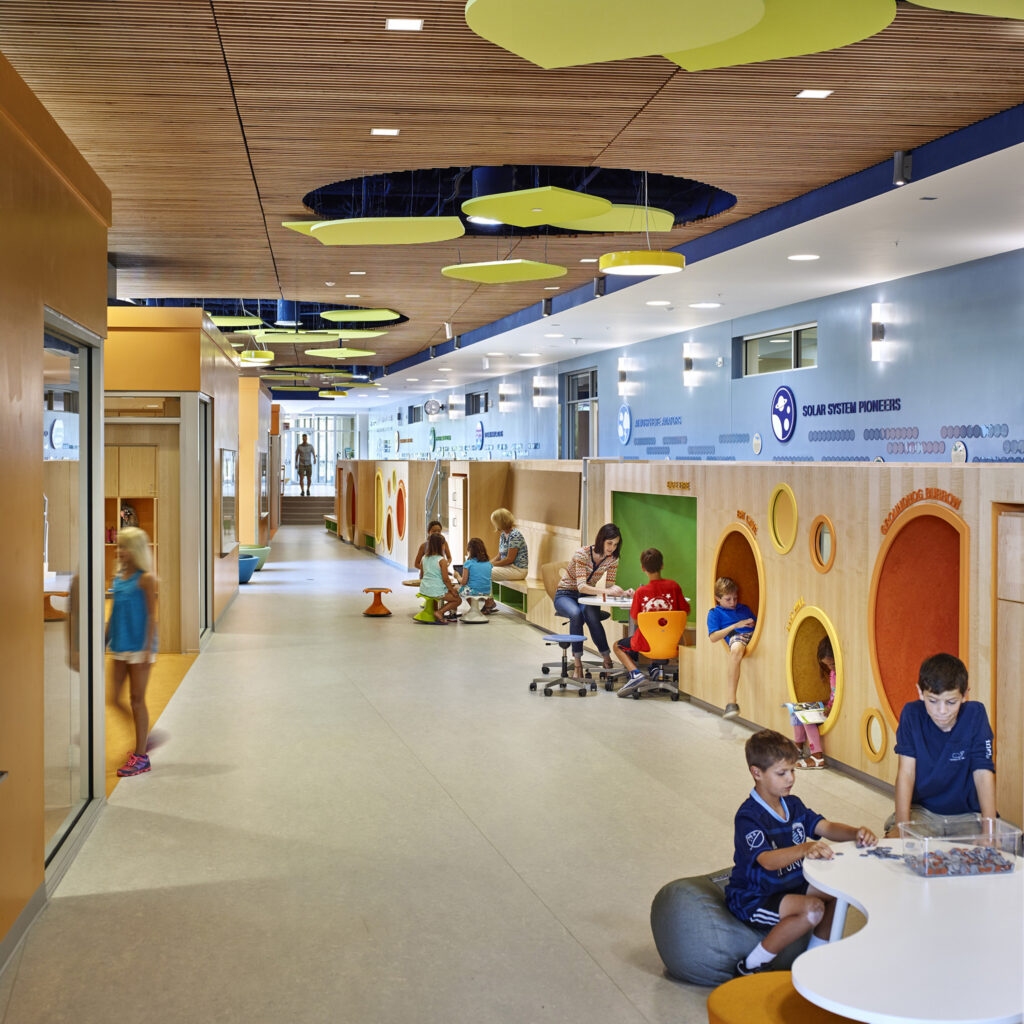
Manassas Park, Virginia. A school system where students preferred away games because they were ashamed of their facilities. A superintendent named Tom DeBolt who was, as more than one participant put it, relentless – relentless in his demands for excellence, in his confidence in his community, in his vision for what a building could do for children who had been given so little.
The site was rugged, at the edge of a business park. The students were largely on reduced lunch; their classrooms temporary trailers installed thirty years earlier, floors riddled with holes that had never been fixed. VMDO arrived with ideas about education and site and the three-dimensional arrangement of a school. They worked.
“It was really an underdog story, a turnaround story,” Joe Celentano said.
When the high school was complete, VMDO staff traveled to Manassas Park to help teachers move books and supplies into the new building. Shopping carts carried materials from the old Quonset hut trailers into rooms built to last. Tom brought pizza afterward.
What began as a practical act of assistance became a tradition that continues today. What began as a single high school became a twenty-year relationship that would transform an entire school system.
Still Making the Mark
In the first DECADES session, Bob Vickery’s founding question was recalled: What does it mean to make a mark upon the land?
This decade offered one answer. A mark is also made by staying when it would have been easier to go. By cutting a salary in half to keep a practice alive. By showing up with shopping carts to help teachers move into a building designed for children who deserved better. By building a school in the Blue Ridge foothills that thirty years later still earns recognition for what it did right.
The clients like our work, Bob Moje had said in the first session. And most of the people I’ve worked with on major projects are still my friends.
That, too, is an answer.
Decades: Design Thursday is a series marking VMDO’s 50th anniversary. Each session gathers colleagues across generations to reflect on a decade of practice. Next: 1996 to 2005.