Decades Series 2006–2015: Becoming a Household Name with Michele Westrick, Wyck Knox, and Joe Atkins

Maggie Thacker
DECADES is VMDO’s internal conversation series tracing fifty years of practice, one decade at a time.
The fourth session covered 2006 to 2015.
What follows is not a summary. It is an attempt to honor what was said.
A Poem
Wyck Knox has a habit of marking the equinox and the turn of seasons with poetry, a practice that says something about how he moves through the world. So when he speaks about a poem written by a second grader at Discovery Elementary School in the building’s first year of life, it carries weight.
I’m a bird who flew out of a wooden house, who flew through the whispering leaves of the forest.
And soared over the depths of the ocean.
Then I went into the atmosphere, spinning through sparkling snow
and flew into the solar system, dancing through twinkling stars
and flew into the Galaxy, where I thought I came from a backyard.
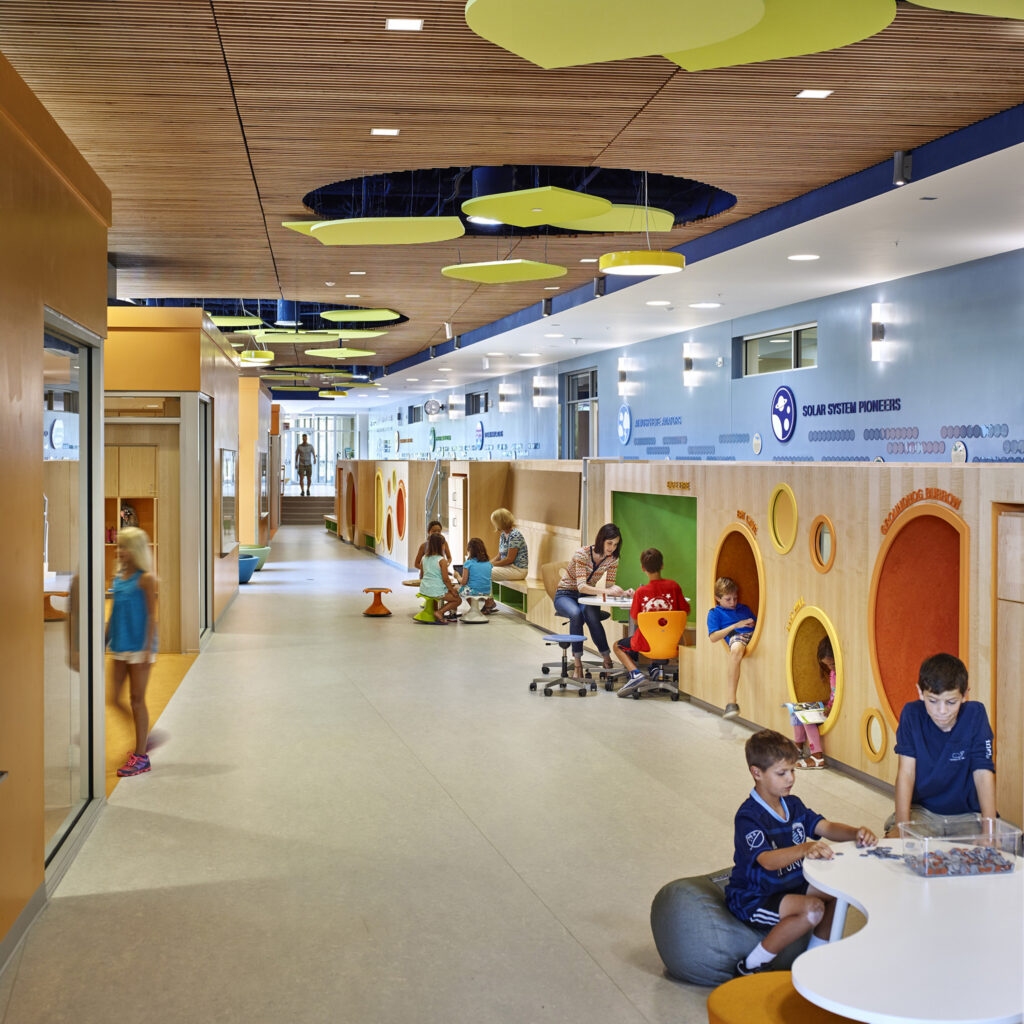
That poem was written in response to a building. The building moved through environmental graphics from backyard ecosystems to the observable universe, a sequence designed so that children, as they aged and moved through the school, understood themselves as part of something ever larger.
“It’s the most impactful thing,” Wyck said, “that anyone has ever said about our work.”
A Dizzying Pace
The decade began in the shadow of the 2008 financial crisis. VMDO managed the downturn more carefully than 1990, a slide from 47 to 38 staff rather than 55 to 13, and navigated it in part through a growing body of work at Liberty University. The projects came steadily, then in volume. By mid-decade, Liberty represented nearly half the firm’s revenue. The risk was recognized. Diversification became intentional.
Meanwhile, sustainability moved from intuition to measurement. “Whatever you do, stay gold” became a refrain in K-12 conversations, a reference to LEED Gold and to a standard the firm had set for itself. Manassas Park Elementary School became one of the few schools in the country with measurable post-occupancy data. Wayland Hall at James Madison University became the first LEED Platinum housing renovation in the country.
“People around the country were paying attention,” Wyck recalled. “Who is this little firm in Charlottesville called VMDO?”
The practice expanded rapidly. Residential life work at Georgia Tech and Clemson opened new territory across the Mid-Atlantic and Southeast. Libraries, performance spaces, and a deepening athletics practice brought new design questions.
The University of Virginia’s John Paul Jones Arena came through a design competition, one of VMDO’s largest to that point, and it was won in part because the firm had been inside the sport for a long time. VMDO had been building that trust across UVA athletics for nearly two decades: the basketball locker room renovation that had been Joe Celentano’s first project, Klöckner Stadium, a succession of smaller commissions across different programs and venues. That accumulation, built one project at a time, meant VMDO understood how athletes move through buildings, how a building can lift or diminish performance, how a crowd inhabits an arena differently than an architect imagines from a plan. By the time JPJ opened, VMDO had touched nearly every sport at UVA, a partnership that continues to this day.
Sports Illustrated named John Paul Jones Arena the best new college basketball facility of the decade, recognition from an audience that didn’t read architecture magazines, which was, in its own way, the highest compliment.
Seven national AIA awards in the decade. Two COTE Top Ten awards. Three CAE awards.
The Joy of It
Somewhere in this decade, a word entered the firm’s design thinking that hadn’t quite been there so explicitly before.
Joy.
At Buckingham Elementary, the design team reached for local Buckingham slate as the school’s central material expression, not just as cladding, but as storytelling. The slate appeared in paving, flooring, stormwater channels, benches, counters. It told children the story of the county’s cultural history, its geological past, its sustainable future. A material from the ground beneath them, worked into the building around them.
The Robert Wood Johnson Foundation took notice and funded a documentary about how architecture could be used to combat childhood obesity – a building as public health intervention.
At Poquoson Elementary and Manassas Park Elementary, rainwater cisterns, outdoor classrooms, and themed interior areas brought the landscape inside. At Buckingham, the design team stopped to ask a question that felt almost too simple: what if we designed things that were just for the joy of children? No further justification required?
“I think that was the first project where we really said, hey, joy is important,” Wyck Knox recalled. “Really important.”
Discovery Elementary followed – and pushed that idea to its limit. An oculus built into the school’s entry plaza allowed students to track the path of the sun on a solar calendar. A real-time energy dashboard let them see how cloud cover affected power production at rooftop photovoltaic panels. The school went net-zero, then did something remarkable: its success convinced Arlington Public Schools to make net-zero energy a requirement for all new construction. At the state level, school leaders lobbied the Virginia Assembly to pass legislation allowing net-positive schools to sell excess energy back to the grid.
A building changed a procurement standard. A building changed state law.
The environmental graphic work across these projects was led in large part by Brittany Butler, a member of VMDO’s marketing team who found a new design calling in K-12 and eventually left to found her own firm, Iconograph.
“I like to think,” one participant said, “that we incubated a small female-owned business here.”
A Broader Definition of Us
The decade brought changes that went beyond projects.
At the start of it, eight male principals and associate principals led the firm. By 2010, that was changing. The first female principals were elevated. Deliberately. Kim Smith and Michele Westrick were among the first female architects to return to VMDO after having children, with no model or precedent to follow. One traveled for projects with overnight babysitters lined up at home. The other came in early and stayed late and figured it out one day at a time. They didn’t have a roadmap. They made one.
“The door opened for women,” Wyck Knox said, “to start moving into positions where they were going to be heard.”
The culture extended outward too. Staff built treehouses in each other’s backyards, helped with home renovations, and spent evenings together that had nothing to do with deadlines. A third consecutive generational leadership transition was underway, and an architect named Bruce Wardell observed, from the outside, what he found remarkable: each time VMDO handed off to a new generation, the work got better and more forward-looking, not simply continued.
“I think that was a beautiful thing to say,” Joe Celentano reflected, “and I also think it’s true.”
Still Asking
Bob Vickery’s question — What does it mean to make a mark upon the land? — was first asked in a classroom a mile from where this firm was founded.
In this decade, a second grader answered it.
She wrote about a building that started her in a backyard and ended her in a galaxy. She is somewhere in college now, carrying that building with her in whatever way buildings travel forward in a person.
The mark was made. The mark is still moving.
Decades: Design Thursday is a series marking VMDO’s 50th anniversary. Each session gathers colleagues across generations to reflect on a decade of practice. Next: 2016 to 2025.