Decades Series 1996–2005: The People Behind the Work with Ken Thacker, Kim Smith, and Randy Livermon

Maggie Thacker
DECADES is VMDO’s internal conversation series tracing fifty years of practice, one decade at a time.
The third session covered 1996 to 2005.
What follows is not a summary. It is an attempt to honor what was said.
The First Lesson
When a new hire arrived at VMDO in the late 1990s, David Oakland sat him down and said: come on, let me tell you about this project. The young architect settled in, expecting to hear about buildings, materials, program. What he got was two hours about people: the specific individuals he would meet on the client team, their concerns, their history, what drove them and what they feared.
It was humbling. It was intentional. It was, in retrospect, the entire pedagogy of the firm compressed into a single afternoon.
“He knew you better have them figured out,” Ken Thacker recalled, “and he knew that.”
An Office Full of Life
The office in this decade was alive in ways that are hard to separate from the work itself. It stayed lit well past midnight. Staff returning after bedtime at home said walking back in felt less like going back to the office than returning to a room that was glad to have them: the stereo going, a game of horse underway at the basketball hoop counterweighted to fold flat into a conference table when meetings demanded it. The hoop wasn’t only for fun. VMDO was deep in the design and delivery of a new basketball arena at the University of Virginia, and understanding the sport from the inside, the sightlines, the geometry, the feel of the space from the court, mattered. The hoop stayed. Design Thursday required, as Randy Livermon put it, twelve beers and a loaf of bread from the wine shop.
In 1998 alone, enough children were born to staff members that the office joked about opening a VMDO daycare.
That was VMDO in those years: people at every stage of life, raising kids, launching careers, all of them showing up for each other as much as for the work.
Passing it Down Before They Had To
Bob Moje and David Oakland were in their forties. They were at the peak of their architectural careers. And they had already begun the work of entrusting it.
Not by stepping back, but deliberately, carefully, with a clarity that struck everyone in the room as remarkable. They began identifying and elevating the next generation of leadership. Project design and documentation shifted steadily to younger staff. Principals in their thirties were already being developed.
“That was awfully visionary,” Ken Thacker said, “and an amazingly unselfish thing to do.”
By 2005, a new generation of principals had emerged. Scott Stadium at the University of Virginia — a 60,000-seat renovation and expansion, the firm’s largest and most complex project to date — proved the new leadership could operate at a scale few Virginia firms had ever attempted. Delivered alongside Heery International and modeled in MicroStation for the first time, it required a different kind of management, a different kind of coordination, a different kind of confidence. UVA had watched VMDO build trust for nearly two decades, from a locker room renovation to Klöckner Stadium to Hereford Residential College. The stadium was the return on all of it.
“We just did one little project after another,” Randy recalled, “and then the door opened.”
In 2003, VMDO received the T. David Fitz-Gibbon Virginia Architecture Firm Award, the state’s highest recognition for a practice. And that same year, a designer named Jim Kovach partnered with an Enterprise Rose Fellow named Katie Swenson to found the Charlottesville Community Design Center, using the design process as a civic tool for making the region more equitable. Bob Moje and the VMDO leadership supported it. Dozens of staff joined as volunteers. The firm was becoming what it had always believed it should be: part of its community.
The Girl at the Fence
None of it, though, compared to what a superintendent named Tom DeBolt had set in motion in Manassas Park.
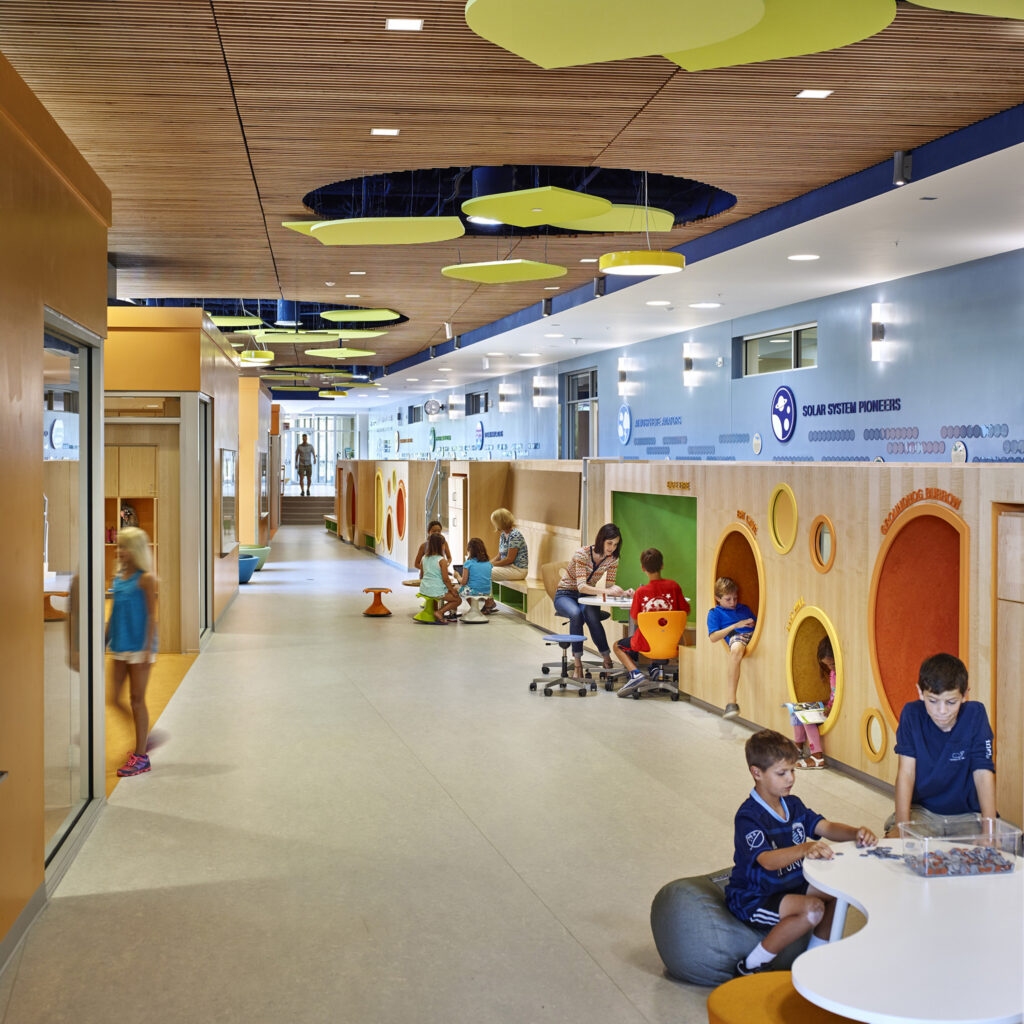
The community had a thin tax base, students on reduced lunch, and facilities that were falling apart. There were classrooms installed as temporary trailers thirty years earlier and floors with holes that had never been fixed. Students preferred away games. They were ashamed of where they played.
Eight current or future principals of VMDO worked on the high school together, guided by what Ken Thacker called Tom’s Dream Team: teachers and administrators recruited to co-design the school alongside the architects.
“He wasn’t going to hand us a program and have us go away for nine months,” Ken recalled. “We invited them on board our train. They were with us the whole time. We went on field trips. We listened to teachers talk about what they were doing in education — younger, innovative teachers, hungry to help kids learn in better ways.”
When the building was under construction, Tom brought children to the site to see it rising. Standing at a construction fence, a girl looked at what was being built for her community and wept.
“Why are you showing this to me?” she said. “Nobody would build anything this nice for us.”
That fall, after the school opened, Tom called to report that standardized test scores had improved. He was certain the buildings had something to do with it. That year, the Manassas Park Cougars won the state high school football championship, from a community that had once refused to host home games.
“That’s how we change lives,” Ken said. “And that’s what I want people to remember, the why of what we do.”
A Broader Perspective
The firm was expanding in other ways too. Staff served as president of AIA Central Virginia. Women in Design gathered at the office on Monday evenings. After Hurricane Katrina, VMDO partnered with Building Goodness Foundation to help with rebuilding efforts, the start of an enduring relationship. Studio structures began to take shape as expertise deepened.
The era had a democratic tone. Ideas moved freely across project types and experience levels. Transparency about firm finances, decisions, and the reasoning behind them became part of how the next generation was prepared to lead.
“This transparency about how we work, how we can be profitable, how we can share those profits with others,” Kim Smith reflected, “that’s a really, really big change.”
“That’s how we change lives,” Ken said. “And that’s what I want people to remember — the why of what we do.”
Some questions don’t get answered. They get demonstrated.
A Note From Randy
Randy Livermon closed with six things he hopes the firm carries forward:
- Open studios, open dialogue. Let everyone participate.
- Make everything as good as it can possibly be. It’s never done until it’s glued and screwed.
- Say we, not I.
- Hire people smarter and more talented than you.
- Keep this a teaching firm.
- Stay open to the possibility of change.
While preparing for the session, he had found an old folder of VMDO work on the covers of architecture magazines. He thought of what his mother used to tell him.
Don’t forget where you came from.
Decades: Design Thursday is a series marking VMDO’s 50th anniversary. Each session gathers colleagues across generations to reflect on a decade of practice. Next: 2006 to 2015.