For 50 years, VMDO has held its mission as a teaching firm: not only one that specializes in designing educational buildings, but also as one that prioritizes employee growth and building collective knowledge. The Travel Fellowship program is one of many ways VMDO invests in its staff. Open to all non-leadership staff, VMDOers can apply to travel nationally or abroad to study architecture, design, building techniques, and the cultures that create and influence them all over the world. In 2023, architect James Atkins used the Travel Fellowship to explore aural architecture in Berlin, Germany.
With my Travel Fellowship, I had the great privilege of spending nearly two weeks in Berlin, Germany studying aural architecture. Aural architecture is a term that describes aspects of a space that are experienced by listening, prioritizing the sense of hearing over seeing or feeling. As Ellen Lupton writes,
“Sound is experience… Designers engage with the lived, bodily phenomenon of sound…Whether heard with the ears or felt with the body, sound envelops us in the rich murmur of being.”
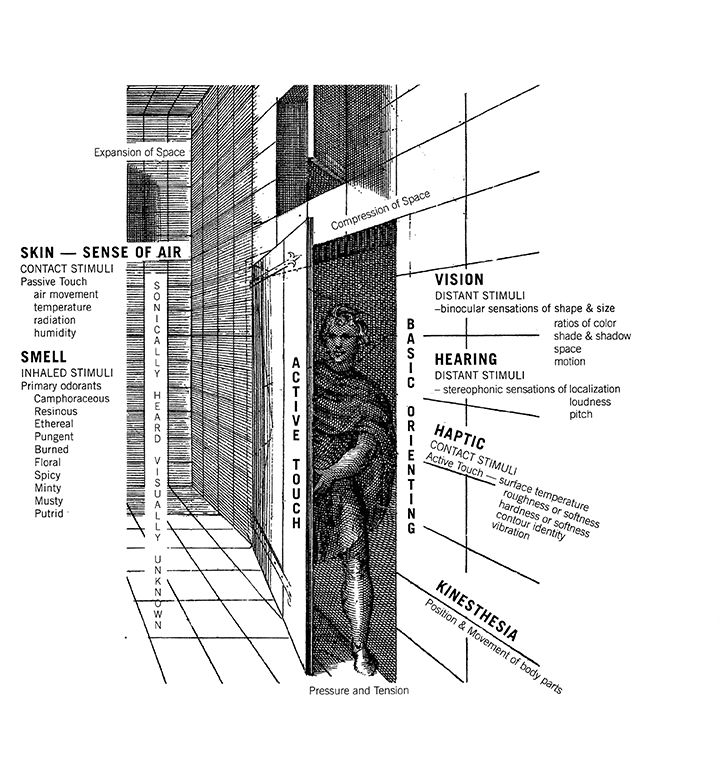
As a classically trained pianist, organist, and countertenor, I have always been sensitive to the acoustic dimension of space. Not only do I see the world through an architect’s eyes, but I also hear the world through a musician’s ears. Spatial acoustics is a very important topic to me, and I strive to prioritize the sound of a space in my design work.
In formulating my proposal, I built a list of acoustic wonders of the world, both natural and architectural. I found that the greatest concentrations of these spaces were in Germany. As I continued to dive into the architectural stock of Germany, specifically in Berlin, I found many buildings that were important not only to architectural history but also to music history and world political history. In addition to important concert halls and other performance spaces, I found many sites for contemplation and remembrance where sound plays a major role in spatial experience.
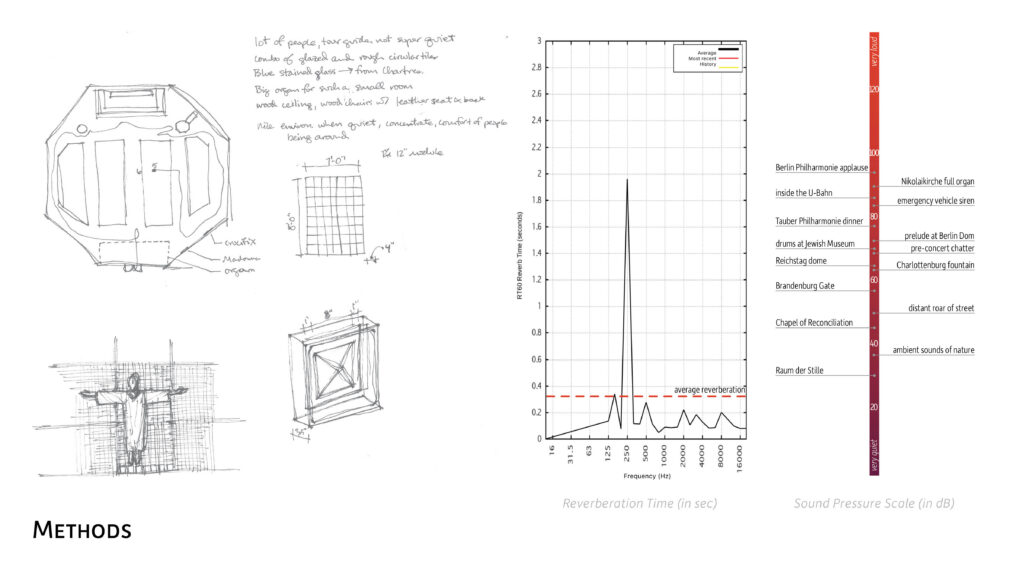
To document my experiences, I relied on both analog and digital means for gathering data. I sketched, took notes, and tried to be a keen observer as I explored. In addition to taking pictures and audio recordings, I utilized two important apps for measuring spaces. One called “Decibel X” measures levels of sound pressure. The decibel scale is a logarithmic scale, which means that values increase exponentially rather than linearly. The other one called “ClapIR” measures spatial reverberation time. Though these tools are rudimentary at best, they were useful in developing a basic understanding of a space’s acoustics.
The timing of my trip coincided with Berlin Musikfest, a month-long series of Classical music concerts at the Berlin Philharmonie. Designed by Hans Scharoun in the mid-twentieth century, the Berlin Philharmonie is a pioneer of the “vineyard style” of concert hall design, where the stage is in the middle of the room completely surrounded by the audience. I attended some amazing concerts on consecutive evenings in the Great Hall, beginning with Gustav Mahler’s Symphony No. 2 “Resurrection Symphony”. With a total of nearly 200 instrumentalists and singers on stage, this work was ideal for observing the huge scale of performance the hall was designed to accommodate. The sound completely filled the hall without being overwhelming. Truly, it is the most transcendent experience I have ever had in a concert hall.
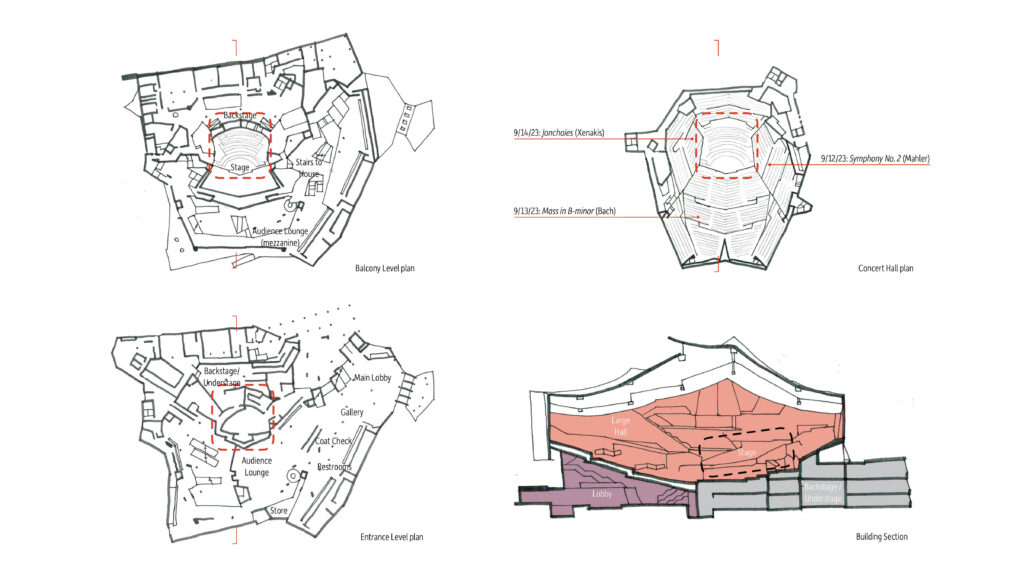
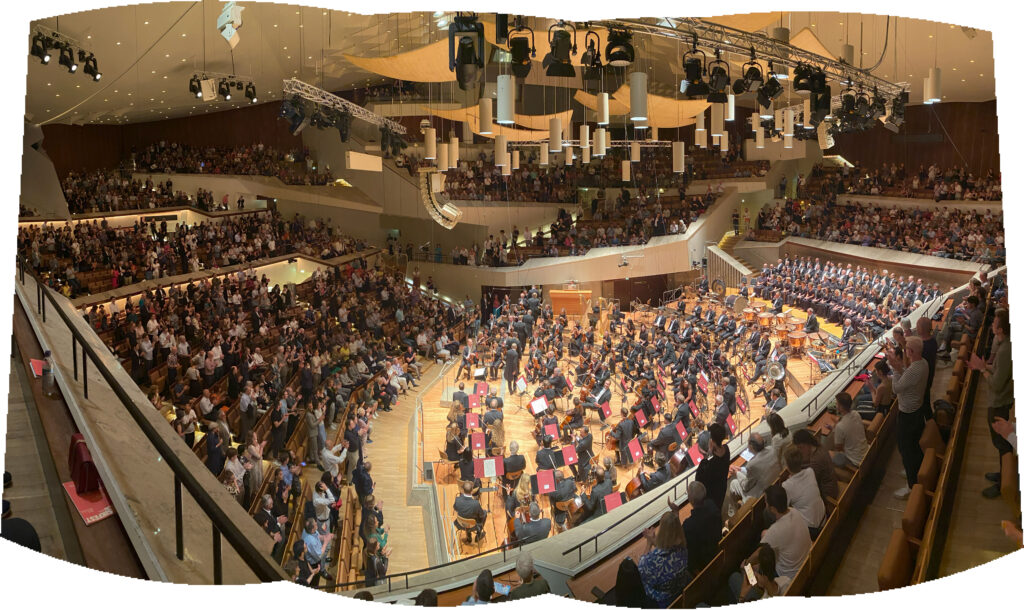
The second night, I attended a performance of J.S. Bach’s Mass in B Minor. It was a very different scale from the previous evening’s performance with only 40 musicians. Though it was a stunning performance and the sound was present, the room felt a little large and reverberant for the scale of the work. After all, Bach composed the Mass to be performed in a church, not a 2,400-seat concert hall. It was quite enlightening to experience two very different masterworks in the same space only 24 hours apart. The space is almost as much a performer as anyone on stage.
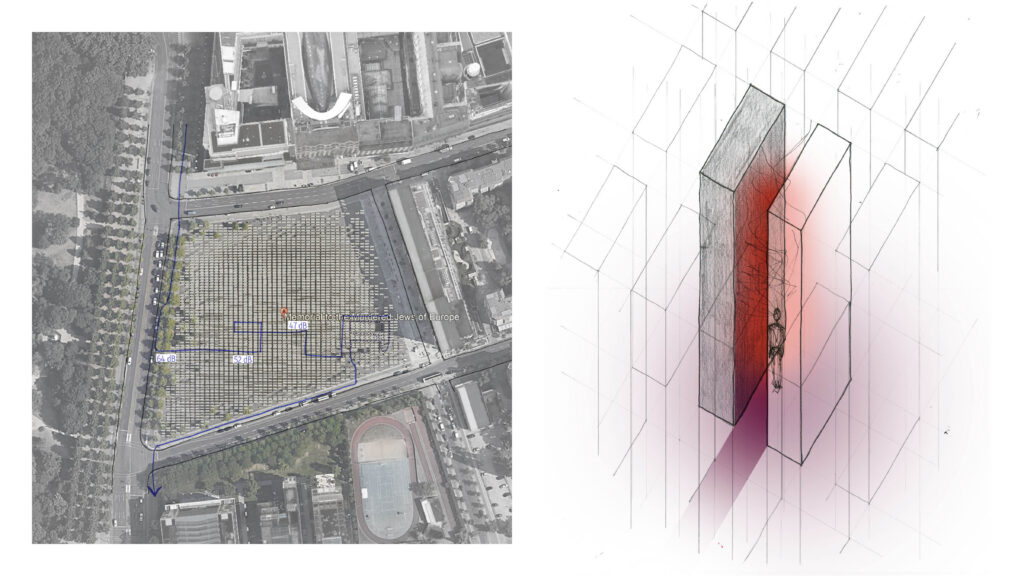
Of the many memorial sites I visited, the Memorial to the Murdered Jews of Europe designed by Peter Eisenman was one of the more memorable sites. Occupying a full city block, this memorial is a grid of 2,700 coffin-like plinths or “stelae”. The ground plane undulates toward the interior of the block: while the stelae are 18” tall at the sidewalk, they grow to almost 18’-0” tall in the middle of the memorial. Approaching the middle of the block becomes increasingly disorienting as the stelae rise above your head. You lose connection to the street, and the experience becomes quite maze-like. Every three or four paces, you catch a flash of a person moving in the periphery. It’s alarming and a bit stressful. I also discovered an interesting acoustic effect on this site. The tight parallel surfaces of the stelae create a flutter echo effect, a ‘buzz’ in any sound made between them. When the stelae reach a certain height, that flutter resonates on pitch! The narrow space vibrates like a pipe for a split second.
Arguably the most memorable experience from the trip happened in a place I did not plan to visit. Following my time in Berlin, I joined some fellow VMDO colleagues for the VS America Days conference in the Tauber region of Baden-Württemberg. During a dinner event at the Tauberphilharmonie in Weikersheim, I was invited to perform for the other conference attendees. I was so nervous that I barely touched my dinner! To have the opportunity to play a concert grand piano in a well-designed hall, it was a truly unforgettable experience.
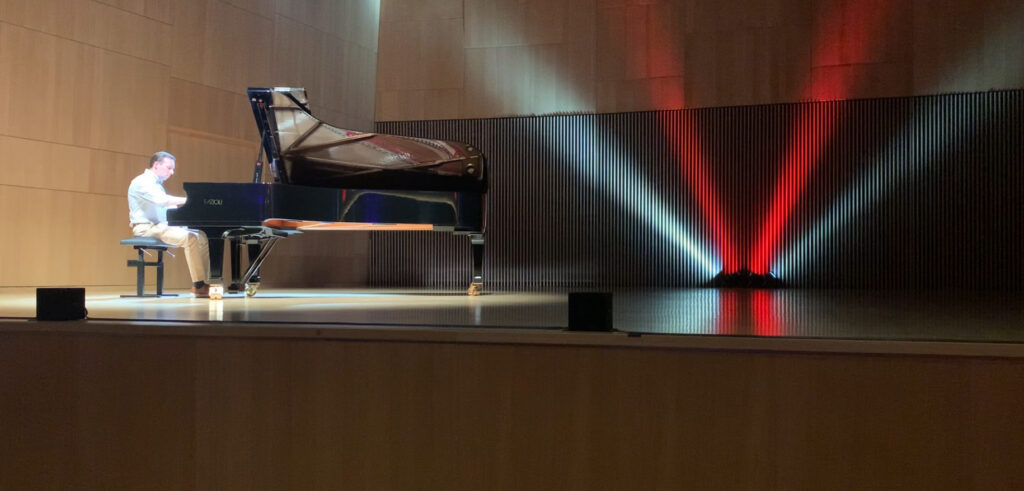
This Travel Fellowship experience afforded me a wonderful opportunity to explore the interaction of my greatest creative passions: sound and space. My favorite lived experiences of architecture have been those that blend my interests in beautiful places and beautiful sounds. One of my long-term career goals is to design buildings dedicated to the performing arts, spaces that inspire creative expression and unite people with artistic experiences.
-James Atkins, AIA
Recent News
View All